Wed 4.11.12 | Education and Inequality | Against the Grain: A Program about Politics, Society and Ideas: It seems logical: if you don't have enough education your economic prospects will be diminished, while those who have a lot are able to succeed in our purportedly knowledge-based economy. But what if that's only partially accurate? John Marsh posits that economic inequality and poverty are not causally connected to differing levels of education. He argues that we need to reject the appealing notion of education as a cure-all and look deeper at class power and structural inequality.For Their Own Good
Against the Grain radio show has an interview with John Marsh on the popular idea that more education will somehow fix the poverty issue. Most recently, there has been a huge push to raise compulsory attendance laws and many states have done so. The reason usually cited is that drop outs do worse on lifetime earnings and therefore, heavy police tactics to keep kids in school is actually helping them.
It is another instance where lawmakers and the schools themselves rely on policing and authoritarian practices instead of figuring why kids drop out and working with them to make system changes. Compulsory attendance laws have eliminated that feedback loop, the mechanism that makes businesses listen to their customers (though we have corporations lacking that mechanism as well).
It is, of course, clearly a matter of money as schools have tied attendance to funding and raising compulsory attendance laws at a time when states have cut school funding is clearly a way to raise revenues. Concern for the welfare of young people is not the motivation in the US where we have large numbers of teens sentenced within the justice ... penal system ... as adults every year.
Schooling and Poverty
John Holt wrote about the impossibility of schools changing inequality is his essay, "Schooling and Poverty."
"The word 'poverty' is too general, too vague. Let me try to make it more concrete by suggesting that it has three parts: employment, income, and material standard of life. A man feels poor and is poor when he has a bad job or no job, lacks money, and can't get the things he needs. ...
In short the schools, whether by what they teach or the amount of degrees they give out, do not determine and cannot change the shape of the job pyramid. The number of jobs that exist, and the goodness or badness of these jobs and the amount of money they pay, are independent of the schools, the things they teach there, the number of people who are learning them.
It would be the most hard-headed economic and political realism for us to guarantee and provide to every American man, woman, or child, an income on which he can live decently and comfortably, whether he has a 'job' or not."More on Class Dismissed
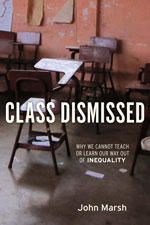
Class Dismissed :: Monthly Review Press: "In Class Dismissed, John Marsh debunks a myth cherished by journalists, politicians, and economists: that growing poverty and inequality in the United States can be solved through education. Using sophisticated analysis combined with personal experience in the classroom, Marsh not only shows that education has little impact on poverty and inequality, but that our mistaken beliefs actively shape the way we structure our schools and what we teach in them.
Rather than focus attention on the hierarchy of jobs and power—where most jobs require relatively little education, and the poor enjoy very little political power—money is funneled into educational endeavors that ultimately do nothing to challenge established social structures, and in fact reinforce them. And when educational programs prove ineffective at reducing inequality, the ones whom these programs were intended to help end up blaming themselves. Marsh’s struggle to grasp the connection between education, poverty, and inequality is both powerful and poignant."
And an interview with Marsh is here:
learning about inequality: gapminder
blaming families, juvenile justice edition
schools could help us address poverty
voluntary attendance
the compulsory attendance mindset
side effects of the literacy factory model
make public schools truly public
what's wrong with the schools?
participatory democracy in schools
Rather than focus attention on the hierarchy of jobs and power—where most jobs require relatively little education, and the poor enjoy very little political power—money is funneled into educational endeavors that ultimately do nothing to challenge established social structures, and in fact reinforce them. And when educational programs prove ineffective at reducing inequality, the ones whom these programs were intended to help end up blaming themselves. Marsh’s struggle to grasp the connection between education, poverty, and inequality is both powerful and poignant."
'Class Dismissed' | Inside Higher Ed:background
"Regarding inequality, I would point to the findings of Richard Wilkinson and Kate Pickett, who have shown that people who live in more equal countries live demonstrably better lives than those who live in less equal countries. In more equal countries, people — rich and poor alike — live longer, trust each other more, discriminate against women less, devote more resources to foreign aid, have fewer bouts of mental illness, use fewer drugs, murder each other less, have lower rates of infant mortality, suffer less from obesity, are more literate and numerate, complete more years of schooling, imprison fewer people, and enjoy greater social mobility. People in more equal countries even have fewer fistfights than people in less equal countries. As an English professor, I enjoy a good fistfight as much as the next person, but I think we could safely get by with fewer of them." via Blog this'
learning about inequality: gapminder
blaming families, juvenile justice edition
schools could help us address poverty
voluntary attendance
the compulsory attendance mindset
side effects of the literacy factory model
make public schools truly public
what's wrong with the schools?
participatory democracy in schools


