Showing posts with label education. Show all posts

class dismissed author interview

Wed 4.11.12 | Education and Inequality | Against the Grain: A Program about Politics, Society and Ideas:  It seems logical: if you don't have enough education your economic prospects will be diminished, while those who have a lot are able to succeed in our purportedly knowledge-based economy. But what if that's only partially accurate? John Marsh posits that economic inequality and poverty are not causally connected to differing levels of education. He argues that we need to reject the appealing notion of education as a cure-all and look deeper at class power and structural inequality.
For Their Own Good
Against the Grain radio show has an interview with John Marsh on the popular idea that more education will somehow fix the poverty issue. Most recently, there has been a huge push to raise compulsory attendance laws and many states have done so. The reason usually cited is that drop outs do worse on lifetime earnings and therefore, heavy police tactics to keep kids in school is actually helping them.

It is another instance where lawmakers and the schools themselves rely on policing and authoritarian practices instead of figuring why kids drop out and working with them to make system changes. Compulsory attendance laws have eliminated that feedback loop, the mechanism that makes businesses listen to their customers (though we have corporations lacking that mechanism as well).

It is, of course, clearly a matter of money as schools have tied attendance to funding and raising compulsory attendance laws at a time when states have cut school funding is clearly a way to raise revenues. Concern for the welfare of young people is not the motivation in the US where we have large numbers of teens sentenced within the justice ... penal system ... as adults every year.

Schooling and Poverty
John Holt wrote about the impossibility of schools changing inequality is his essay, "Schooling and Poverty." 
"The word 'poverty' is too general, too vague. Let me try to make it more concrete by suggesting that it has three parts: employment, income, and material standard of life. A man feels poor and is poor when he has a bad job or no job, lacks money, and can't get the things he needs. ... 
In short the schools, whether by what they teach or the amount of degrees they give out, do not determine and cannot change the shape of the job pyramid. The number of jobs that exist, and the goodness or badness of these jobs and the amount of money they pay, are independent of the schools, the things they teach there, the number of people who are learning them.
It would be the most hard-headed economic and political realism for us to guarantee and provide to every American man, woman, or child, an income on which he can live decently and comfortably, whether he has a 'job' or not." 
More on Class Dismissed 
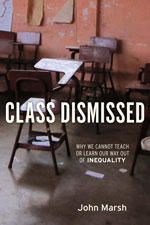
Class Dismissed :: Monthly Review Press:   "In Class Dismissed, John Marsh debunks a myth cherished by journalists, politicians, and economists: that growing poverty and inequality in the United States can be solved through education. Using sophisticated analysis combined with personal experience in the classroom, Marsh not only shows that education has little impact on poverty and inequality, but that our mistaken beliefs actively shape the way we structure our schools and what we teach in them.

Rather than focus attention on the hierarchy of jobs and power—where most jobs require relatively little education, and the poor enjoy very little political power—money is funneled into educational endeavors that ultimately do nothing to challenge established social structures, and in fact reinforce them. And when educational programs prove ineffective at reducing inequality, the ones whom these programs were intended to help end up blaming themselves. Marsh’s struggle to grasp the connection between education, poverty, and inequality is both powerful and poignant."

And an interview with Marsh is here:
'Class Dismissed' | Inside Higher Ed:

"Regarding inequality, I would point to the findings of Richard Wilkinson and Kate Pickett, who have shown that people who live in more equal countries live demonstrably better lives than those who live in less equal countries. In more equal countries, people — rich and poor alike — live longer, trust each other more, discriminate against women less, devote more resources to foreign aid, have fewer bouts of mental illness, use fewer drugs, murder each other less, have lower rates of infant mortality, suffer less from obesity, are more literate and numerate, complete more years of schooling, imprison fewer people, and enjoy greater social mobility. People in more equal countries even have fewer fistfights than people in less equal countries. As an English professor, I enjoy a good fistfight as much as the next person, but I think we could safely get by with fewer of them." via Blog this' 
background
learning about inequality: gapminder
blaming families, juvenile justice edition
schools could help us address poverty
voluntary attendance
the compulsory attendance mindset
side effects of the literacy factory model
make public schools truly public
what's wrong with the schools?
participatory democracy in schools

a single mother's reflection on race and education

A good article, Class of 2010: A Single Mother's Reflection on Race and Education up at Race-Talk The author calls for activism and parental involvement:

Finally, our schools and kids need your support. We need you to become education activists who work on addressing the root causes of the racial achievement gap. Become a mentor or tutor. Take parenting classes. Support allied groups and agencies that help to alleviate poverty in your community. Financially support those organizations that teach inner-city kids to achieve in school. Volunteer at your local YWCA and help promote equity in education. Challenge your local school board to examine its policies through a structural racism framework. Be an active engaged parent at every stage of your student’s development. Start a grass-roots group to help parents organize and become better advocates for their children. Support policies that help good teachers become excellent teachers, and learn more about how to stop the school to prison pipeline and close the racial achievement gap.
In East Africa there’s a Maasai custom that doesn’t ask  “How are you?,” they ask, instead “How are the children?”
Stop.  Look around you.  Look all around you.  How are our children?

don't miss the boat

The eloquent Marian Wright Edelman is a moving speech at the One Nation Working Together rally in Washington DC. The broken school system is wasting our human capital, our children, but Ms. Edelman says it much better than I. A favorite part of the speech:
Lesson six—almost done—remember that the Ark was built by amateurs, the Titanic was built by professionals. Use your citizen power, your vote, to wrest our ship of state from that small group of experts and powerful and greedy corporate pirates who recklessly jeopardized all of our lives for personal gain. Feel your own power. Use your own power. Don’t rely on experts.


National Day of Action to Defend Public Education

Democracy Now! on the student protests about public education.  From the show:

ANANYA ROY: Well, we are beginning to look at a systematic destruction of the system of public education in California. And I think we’re feeling the effects of this. So, yes, much fewer students are able to join the community college systems, to enter the UC system, not only to be able to afford a college education in California, but to even be able to get into college. The community colleges turned away 40,000 students this year. And, of course, the K-through-12 cuts have a huge impact on whether or not students are able to get into colleges that they deserve to be educated at. So we have seen a horrible slide in California’s position in education in both the country and internationally. California now is forty-ninth out of fifty states in the number of adults with high school education. Its position in terms of the number of adults with college education continues to slip. And this does not bode well for California’s future.

So, if Californians care for nothing else other than economic competitiveness and job creation and economic recovery, then they have to pay attention to these trends. Many of us care for much more. We care about issues of social justice. We care about equality of opportunity. And when one cares about those issues, one has to pay attention to who is able to get into college, whether education has become a privilege for the minority or whether it is a widely held right.

can money buy education?

The answer to the title of Shannon Hayes' article at Yes!, "Can Money Buy Education?" is decidedly yes: you can buy a college degree, it will be called education, and you will make more money if you can get one of these things.  It is a credential that ensures you make more money and it is designed that way.  And it can definitely be bought: from straight cash to SAT prep courses, in fact, standardized testing has been perfected to only test exactly this linkage between class and high standards. 

And the answer is also decidedly, no:  all kinds of money and Ivy League degrees could not enable the vast majority of economists and thinkers to foresee the largest economic crisis in more than 60 years, it has not enabled modern doctors to perform breech births and keep caesarian rates low, it has not enabled agricultural colleges to foster organic agriculture, the list could go on.

That academics succumb to peer-pressure and that our education system is designed to ensure class status isn't news to anyone but the large number of Americans who have grown used to the idea of themselves as the beneficiaries of wealth on their personal merit.  We have heard that meme expounded relentlessly in the last thirty years and the subtle temptations of it have beguiled many.

professional educators on schools

Here is Andres Alonso , CEO of Baltimore schools, and the fact that the talks about the kids first is good.  But competition is not the basis of future economies and the very idea of having our kids compete is a losing game that justifies the attempts to weed out losers from winners. (More here in my post competing our way to change?)


In a country where taxpayers pay for this social service, grading has no place.  Evaluation and feedback can be given to parents by teachers and students themselves can select what and how to be graded as they build a portfolio for their future.  Homeschoolers do this very successfully and their model will work for kids in school.

These are simple changes to implement but difficult changes to psychologically grasp.  This is especially true because we now have several generations with experience in the public schools and so few are able to envision any alternatives. This common psychological conditioning predisposes us to many things, from acceptance of institutional violence and authoritarian models, to an inability to actually learn outside a structure.  The cultural baggage is immense and not unlike what breastfeeding advocates encountered when trying to rebuild lost knowledge of breastfeeding and childcare practices.

Public schooling with compulsory attendance has been in place for over a hundred years.  What has changed in that time is our entire economy and social framework.  The schools have not changed much in the way of their practices and structure other than the vastly centralized nature of their administration.  And that is exactly the problem. Fundamental changes to the system are necessary to make schools a modern public social service that are more like community learning centers and far less like Victorian training camps for the poor.

homeschooling case

Here is a disturbing and sparsely detailed news item about homeschooling in Indiana, echoing recent articles on homeschooling regulation.  I cannot help but think that the higher standards advocated by the Department of Education inspire many to help out that mistaken effort thereby accepting those fradulent education goals.  It is also indicative of the loss of generational knowledge of education outside of public institutions.

Education in 1900 took place within a strong community and agricultural structure that receded throughout the 20th century until today, memory of that original context for our current public school system, is lost.  Now many people cannot imagine how education could take place outside the public school system and they accept unthinkingly the right of the state to invade their family life and relationships in the name of education.

It is not unlike what breastfeeding advocates face when they discuss the loss of a breastfeeding culture, a culture where mothers and friends were helpers instead of the current situation where many well-meaning family members and friends often hinder the breastfeeding relationship.  Or childbirth, where high-technology and overeducated medical personnel impede women's ability to give birth in a natural way.  Or like massive, mechanized agriculture, where we grow tomatoes, swollen to a massive size and eerily flawless and completely without vitamins.

In the above item, both parents and court officials seek something far beyond literacy or required attendance, the simple goal of previous generations. They seek education, a deep patterning of social and psychological experience, and something few would chase so fervently if education was not a code-word for class struggle in a society that cannot discuss class status or openly acknowledge it.