Showing posts with label homeschooling. Show all posts

undermining homeschooling

There's a hard and unfeeling undertone to many of the anti-ed reformers discussion of homeschooling. And the jab at homeschoolers (below) was popular with many who read Diane Ravitch. After all, even as they fight ed reformers and No Child Left Behind, this group cannot really support parents and homeschooling.  Just as the NEA is still completely against homeschooling instead of seeing it as a viable option for making stronger families.
Pearsonizing Our Children « Diane Ravitch's blog: "We’ll have Pearsonized their minds, their lives, and their bodies. Here is one true example of the cost we contemplate: “She’s pretty typical. She is a very sedentary child, has been for a long time, really has no experience with activity, no way to think about being active. She’s relatively socially isolated, doesn’t really have very many social opportunities. She’s homeschooled. She has a number of medical problems, in addition to her diabetes.” 
And the example of Pearsonized minds, lives and bodies? A charter school kid drilled into compliance?  No, its a homeschooled teen with health problems. If you click through to the NPR story on diabetes (video below, more at site), you'll find that the quote is from a doctor.


The full quote:
Her doctor is pediatric endocrinologist Phil Zeitler of the University of Colorado
DR. PHILLIP ZEITLER, University of Colorado: She's pretty typical. She is a very sedentary child, has been for a long time, really has no experience with activity, no way to think about being active. She's relatively socially isolated, doesn't really have very many social opportunities. She's homeschooled. She has a number of medical problems, in addition to her diabetes
Dr. Zeitler offers no evidence for her social isolation but he seems to assume this is true because she homeschools, an unfair stereotype that is often leveled at homeschooling.  And an incredible charge when you think about it.

Parents often have to homeschool in order to have the time to care for kids that are ill. Schools will level truancy charges at families with health problems that go beyond the meager sick days allowed and schools do not accomodate chronic illnesses. The use of antibiotics is greatly increased by demands that schools make for attendance and doctor visits -- a parent's word is not considered good enough, they could be lying!


We do know that most teens are not homeschooled and many are unhappy even in schools. From the CDC:
School-Associated Suicides --- United States, 1994--1999: "Suicide-prevention efforts are needed not only to address the risk for school-associated violence, but also to reduce the much larger problem of self-directed violence among adolescents overall. In 2001, suicide was the third leading cause of death in the United States among youths aged 13--18 years, accounting for 11% of deaths in this age group (2). In 2003, approximately one in 12 high school students in the United States reported attempting suicide during the preceding 12 months (3). Data from Oregon indicate that approximately 5% of adolescents treated in hospitals for injuries from a suicide attempt made that attempt at school (4)." 
Homeschooling does not mean social isolation but, like kids in schools, family income plays a large role in most families' social strength. Many kids in schools are socially isolated and bullied and their talents ignored, and again, family income plays a role. We know that what many call socialization in the public schools is an experience of mass coercion, bullying, and intense peer orientation made more so as social capital, families with sufficient incomes, and strong local food supplies have all declined. We know that support for public spaces and public services is threatened in the US and that poor people are more isolated than the middle class and the rich since they cannot buy social venue access. 

This study shows that the better the relationship with the parents and the lessening of peer orientation were associated with more successful treatment of diabetes. And we know that many states do not permit homeschoolers to access sports and activities though some do, so homeschoolers have fewer options, even if their physical or mental health conditions limit their engagement in the factory process. NPR didn't mention that fact nor examine whether the homeschool girl shown had had negative school experiences. Instead they focus on activity and show a young women smiling and playing sports (and eating a poor-quality school meal) and an unsmiling homeschooler, driving (and playing with a pet).

The doctor also attributes the rise in Type II diabetes to social changes, the first of which he mentions is women going back to work (his list of social changes does not include the rise of corporatized food and decline of nutrient values in chemically-treated soil & seeds, the steep decline of wages for families as corporations outsourced jobs, the lack of family leave and maternity leave, the documented decline of social capital, or the continuing inability of doctors and hospitals to support breastfeeding (and here):
DR. PHILLIP ZEITLER: This represents the outcome of a large number of social changes that probably began in the '70s, more mothers working, so the kids were coming home to empty homes, being told to stay indoors, more opportunities for sedentary activities. When I was a kid, you went outside. So, the opportunities for sedentary behavior have increased.
Does this homeschooled teen really have to represent social isolation, obesity, and also corporate school takeover?

Pearson wants to greatly extend harmful practices that are already in place within our schools. I think we need to change the public schools' mission.  We should have schools focused  on working with families and children, not "on their behalf" or against them. I think we need to reconsider many elements in the system, from grading to credential manufacture as a mission.

And I think those fighting ed reform need to truly reach out to homeschooling and learn from it. Ignoring or vilifying homeschoolers and the progressive alternative education movement shows an inability to fully respond to a crisis and move to a better model.

supporting families
blaming parents, blaming the family
blaming families, juvenile justice edition
bullying families and children
every parent should have real choices
deschooling, family style
undermining the family and the child
ngram: school and family


home study in Quezon City

English: Flag of Quezon city, in the Philippines.
Flag of Quezon city, in the Philippines(Photo credit: Wikipedia)
Quezon City in the Phillipines moves toward home study to relieve overcrowding. The Department of Education's desire to supervise the process, a top-down model, undermines the bottom-up model of homeschooling, as educators seek to control the education process. Better to focus on providing support, being flexible, and building new tools by allowing home study students and families to drive services.

Study at home | Inquirer Opinion: "To ease classroom overcrowding and teacher shortage, the Quezon City school division is placing some 10,000 students from six high schools on homeschooling. This would be the biggest number to be covered in a single area since the Department of Education started this alternative mode of teaching.

One of the schools to offer homeschooling is Batasan Hills National High School
(BHNHS), where overcrowded rooms have been a perennial problem. School officials said they’re aiming for a “more bearable” classroom-to-student ratio by sending some 3,000 students to home study. The ideal ratio is one classroom for every 45 students. Since BHNHS’ projected number of students is 13,450 this school year, it is going to accommodate 10,000 while “farming out” the 3,450 through homeschooling, officials said.

Under the program, students can take their lessons at home following modules patterned after the regular curriculum and meet with their teachers only on Saturdays. They graduate with a high school diploma, just like any regular student." 


Ph_locator_ncr_quezon
(Photo credit: Wikipedia)
The DepEd was supposed to have started the program in 2002, but there were years when it was not implemented on a large scale. It has been practiced in Quezon City for three years, and city school’s division officials said the program has worked. “Our students do well,” an official said. “They graduate, go to college and even go abroad.” One wonders how everything about the QC program could be so life-changing when it has only been running for three years. But since Quezon City is now the biggest city division in the country, bigger than Manila, the capital, expect other divisions to follow.
....

But what really goes against homeschooling in the Philippine setting is that it’s supervised and regulated by the DepEd, whose historically poor handling of basic education hardly inspires hope. All of the available studies about the success of homeschooling in the United States pit the performance of homeschoolers against public school students. The Nheri’s 2009 student, for example, declared, that “homeschoolers are still achieving well beyond their public school counterparts.” Regarding calls for more state regulation on homeschooling, the study concluded that the system was doing fine without more government intervention. “That’s a good reason for state governments to redirect scarce funds from regulating homeschooling to where the money is actually needed,” the study said. In short, homeschooling is good, but broader reforms are needed to solve the ills plaguing Philippine basic education.


Students also help with traffic to and from these crowded schools. (hat tip to Zemanta)

homeschooling in Vietnam

By dokientrung (Own work)
 licensed image, via Wikimedia Commons
VietNamNet - Vietnamese getting familiar to homeschooling | Vietnamese getting familiar to homeschooling: "Khanh Huyen, a parent in Hoan Kiem district in Hanoi, said her child is studying at home. A relative of hers, who lives in the US and applies homeschooling to his 
children, has advised her to follow the method.

“
My child can stay at home and learn his lesson any times he wants, instead of going to school early in the morning, returning home late in the afternoon and then struggling with home exercises in the evening,” Huyen said."


Vietnam - Wikipedia, the free encyclopedia:
Education  
Main article: Education in Vietnam
Vietnam has an extensive state-controlled network of schools, colleges and universities, and a growing number of privately run and partially privatised institutions. General education in Vietnam is divided into five categories: kindergarten, elementary schools, middle schools, high schools, and universities. A large number of public schools have been organized across the country to raise the national literacy rate, which stood at 90.3% in 2008.[100]

A large number of Vietnam's most acclaimed universities are based in Hanoi and Ho Chi Minh City. Facing serious crises, Vietnam's education system is under a holistic program of reform launched by the government. Education is not free; therefore, some poor families may have trouble paying tuition for their children without some form of public or private assistance. Regardless, school enrollment is among the highest in the world,[citation needed] and the number of colleges and universities increased dramatically in the 2000s, from 178 in 2000 to 299 in 2005."

unschooling: the new class of learning

Unschooling is getting attention in Europe and this video profiles three unschooling people/families including two Americans, Dale Stevens, of Uncollege fame, and the Emerson family. Also mentioned in the story is the German group playducation.

Unschooling: the new class of learning - YouTube:
In Berlin, we meet a young American who turned his back on school by the time he was 11-years-old. Dale J. Stevens is writing a book that he describes as "a practical guide to learning the skills that school doesn't teach but are requisite for success in the real world". It is based on his experiences as an unschooler but also incorporates the stories of other people who found success in non-traditional ways.

In Paris, we meet the Stern family. André Stern is a well-known name in the world of music but he never went to school. He was raised in a household where passion is considered to be the perfect learning medium and the secret behind competence.

In New York state, the Emerson family are also embracing unschooling. They shun a formal curriculum in favour of encouraging their 12- and 9-year-old children to follow their passions and interests.
Video is also available here, at EuroNews


Enhanced by Zemanta

china: ed reform & homeschoolers


Horse and Groom, handscroll after Li Gonglin b...
Horse and Groom, handscroll after Li Gonglin by Zhao Yong, China, Yuan dynasty, 1347, Freer Gallery (Photo credit: Wikipedia)
An article by Yong Zhao discusses how China wants to move past an education system that emphasizes rote learning and extensive testing. Zhao has written before about how ed reform wants to change aspects of US education that are admired by other countries, like China. Zhao also mentions a Chinese homeschooling association.
  Reforming Chinese Education: What China Is Trying to Learn from America | Solutions:
The aim is to quickly transform a low-level manufacturing economy into one based on knowledge. But a well-educated workforce does not mean simply more years in school, or more testing—as China’s history of training innovators shows. There is currently a surplus of college graduates unable to find work in innovative but elite private firms or oversubscribed government agencies. Meanwhile, the Chinese service industry, the mainstay of the U.S. economy, remains tiny. Unlocking the potential of that industry is going to take a radical overhaul of how the Chinese think about education.
"Homeschooling in China 
Mr. Xu Xuejin, a 39-year-old owner of an international trade firm who retired to homeschool his children in 2009 is behind a controversial national movement in basic education. In December 2010 Mr. Xu established the China Homeschooling Association, which now has nearly 4,000 registered members and its website receives over 200,000 visits daily.10 Homeschooling was unheard of just a few years ago but has become a growing trend that is spreading fast in China.11 The reason behind this movement is widespread dissatisfaction with the test-driven education system that places a heavy burden on students. Although homeschooling in itself is not necessarily a solution, it represents a grassroots movement to seek alternative forms of education, which in turn could drive the Chinese government to loosen control over the school curriculum and hasten the reforms it has been pushing."     via Blog this'
This House Believes in Homeschooling - Caixin Online: 
"Yao Jinghai, an English teacher at the New Oriental School of Jiangsu Province's Yangzhou City opted for homeschooling when his daughter began first grade. "My daughter didn't have many chances to participate in a large class," said Yao, adding that he noticed she had particular needs that weren't being addressed. Compared to her classmates, she excelled at math but required more time on handwriting.

Two years later, Yao says several of his friends also began to homeschool their children after seeing improvements in his daughter. Like many homeschool parents, Yao develop
ed a curriculum based on popular school textbooks and online education materials. Working as a team with his wife, Yao says the method of study is guided primarily by his daughter's own interest in subjects." 


Yong Zhao » Blog Archive » A Discussion on China’s Recent Education Reform on CCTV 9:

previous posts 
yong zhao on testing security
zhao's mass localism: let's get really local
school centralization in China
related
AtoZHomeschooling: China homeschooling page
Enhanced by Zemanta

class dismissed author interview

Wed 4.11.12 | Education and Inequality | Against the Grain: A Program about Politics, Society and Ideas:  It seems logical: if you don't have enough education your economic prospects will be diminished, while those who have a lot are able to succeed in our purportedly knowledge-based economy. But what if that's only partially accurate? John Marsh posits that economic inequality and poverty are not causally connected to differing levels of education. He argues that we need to reject the appealing notion of education as a cure-all and look deeper at class power and structural inequality.
For Their Own Good
Against the Grain radio show has an interview with John Marsh on the popular idea that more education will somehow fix the poverty issue. Most recently, there has been a huge push to raise compulsory attendance laws and many states have done so. The reason usually cited is that drop outs do worse on lifetime earnings and therefore, heavy police tactics to keep kids in school is actually helping them.

It is another instance where lawmakers and the schools themselves rely on policing and authoritarian practices instead of figuring why kids drop out and working with them to make system changes. Compulsory attendance laws have eliminated that feedback loop, the mechanism that makes businesses listen to their customers (though we have corporations lacking that mechanism as well).

It is, of course, clearly a matter of money as schools have tied attendance to funding and raising compulsory attendance laws at a time when states have cut school funding is clearly a way to raise revenues. Concern for the welfare of young people is not the motivation in the US where we have large numbers of teens sentenced within the justice ... penal system ... as adults every year.

Schooling and Poverty
John Holt wrote about the impossibility of schools changing inequality is his essay, "Schooling and Poverty." 
"The word 'poverty' is too general, too vague. Let me try to make it more concrete by suggesting that it has three parts: employment, income, and material standard of life. A man feels poor and is poor when he has a bad job or no job, lacks money, and can't get the things he needs. ... 
In short the schools, whether by what they teach or the amount of degrees they give out, do not determine and cannot change the shape of the job pyramid. The number of jobs that exist, and the goodness or badness of these jobs and the amount of money they pay, are independent of the schools, the things they teach there, the number of people who are learning them.
It would be the most hard-headed economic and political realism for us to guarantee and provide to every American man, woman, or child, an income on which he can live decently and comfortably, whether he has a 'job' or not." 
More on Class Dismissed 
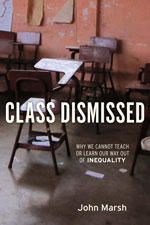
Class Dismissed :: Monthly Review Press:   "In Class Dismissed, John Marsh debunks a myth cherished by journalists, politicians, and economists: that growing poverty and inequality in the United States can be solved through education. Using sophisticated analysis combined with personal experience in the classroom, Marsh not only shows that education has little impact on poverty and inequality, but that our mistaken beliefs actively shape the way we structure our schools and what we teach in them.

Rather than focus attention on the hierarchy of jobs and power—where most jobs require relatively little education, and the poor enjoy very little political power—money is funneled into educational endeavors that ultimately do nothing to challenge established social structures, and in fact reinforce them. And when educational programs prove ineffective at reducing inequality, the ones whom these programs were intended to help end up blaming themselves. Marsh’s struggle to grasp the connection between education, poverty, and inequality is both powerful and poignant."

And an interview with Marsh is here:
'Class Dismissed' | Inside Higher Ed:

"Regarding inequality, I would point to the findings of Richard Wilkinson and Kate Pickett, who have shown that people who live in more equal countries live demonstrably better lives than those who live in less equal countries. In more equal countries, people — rich and poor alike — live longer, trust each other more, discriminate against women less, devote more resources to foreign aid, have fewer bouts of mental illness, use fewer drugs, murder each other less, have lower rates of infant mortality, suffer less from obesity, are more literate and numerate, complete more years of schooling, imprison fewer people, and enjoy greater social mobility. People in more equal countries even have fewer fistfights than people in less equal countries. As an English professor, I enjoy a good fistfight as much as the next person, but I think we could safely get by with fewer of them." via Blog this' 
background
learning about inequality: gapminder
blaming families, juvenile justice edition
schools could help us address poverty
voluntary attendance
the compulsory attendance mindset
side effects of the literacy factory model
make public schools truly public
what's wrong with the schools?
participatory democracy in schools

action by the SPLC

A mother who left the public school system after her son faced a suspension that seemed arbitrary and trivial and who is in the school covering I help with in Mobile Alabama, alerted me to this action after she received notification by the Southern Poverty Law Center:

M.R., et al. v. Board of School Commissioners of Mobile County (Ala.), et al. | Southern Poverty Law Center:
The public school system of Mobile County, Ala., violated the constitutional rights of students by suspending them for months at a time over minor misbehavior without giving parents and guardians an opportunity to defend them. The SPLC filed a federal lawsuit on behalf of six students suspended for apparent minor misbehavior such as un-tucked shirts, tardiness or failing to carry a school ID. 
The students, ranging from 13 to 18 years of age, collectively missed more than 445 school days during the academic year due to these suspensions. School administrators failed to provide any formal notice to the students’ parents or guardians about the grounds for the suspensions or provide an opportunity to challenge the disciplinary action.
The SPLC lawsuit says that the due process clause of the 14th Amendment entitles students to notice and a fair hearing where they can defend themselves before a long-term suspension or expulsion. Long-term suspensions in Mobile County Public Schools ranged from 11 days until the end of the semester. 
In addition to being denied this most basic constitutional right, these students also were denied their right to an education. Students who are suspended miss valuable class time, creating major setbacks in their education and their emotional development.

celebrating john holt

John Holt's writing has a deceptively simple eloquence that is not easy to achieve. In essays like "Schooling and Poverty" and "Deschooling and the Poor" or "Schools Against Themselves" from Freedom and Beyond, Holt grapples with the same issues that surface today in pieces like Dana Goldstein's shock bait "Liberals, Don't Homeschool Your Kids" where Goldstein advises parents to ignore the progressive activism of the past 30 years as well as their own child's needs in support of ed reform. (Perhaps we should stop growing organic and remain within the industrial food model, too.) Holt long ago wrote about these dilemmas with clarity and he offered a simple method any family could use to move outside mass institutions and toward a more humane way of relating. Homeschoolers have since changed the laws in almost all 50 states.

April 14th was John Holt's birthday and Lefty Parent has a very nice tribute to Holt up at his blog:
Happy Birthday John Holt – “Patron Saint” of Unschooling | Lefty Parent: 
"I think Holt is still the “patron saint” of the homeschooling movement to many parents and others in the progressive community. He framed the movement broadly as applying full human and civil rights to children, not just as an alternative venue for school. He represents a continuing thread in our culture carrying forward ideas of more egalitarian rules of engagement between adults and youth from his philosophical predecessors, including A.S. Neill, Homer Lane, Will Durant and Bronson Alcott. 
Here is Holt counseling parents on how to homeschool their children (and a bit of Nancy Wallace, as well), from 1984, in that bastion of left-wing extremism, Mother Earth News:
How to Home School: Home Schooling Requirements and Information - Modern Homesteading - MOTHER EARTH NEWS: "Find out what your state laws say about school attendance, the legal alternatives to it, the possibilities of home instruction or tutoring, and the requirements for setting up a private school. There are several ways to get this information, all of them good." 
One method is to look up the laws yourself. It's easier than you think. Most good-sized public libraries, or law libraries, or lawyers will have a set of all the laws of your state. Look under "Education" in the index of one such collection . . . most or all of what you want will be in this section. Read carefully and copy, if possible, everything dealing with attendance, home schooling, private schools, etc. Also, read and copy everything in your state constitution concerning education and the rights of parents and families.  
Looking up the law yourself is a good exercise. It will help cure you of thinking that the law is a mystery known only to lawyers. Also, since you'll know the regulations yourself, you can speak to school officials with the authority of an expert and can correct them if (as often happens) their incorrect or incomplete version of the law fails to mention some of your important rights. 
And this:
You may also wonder, particularly if you did not do well or go far in school yourself, whether you know enough to help your children with their learning. Again, in my journal you will hear from people without much schooling who are doing a wonderful job of helping their children, mostly because they have been able to discover from the children themselves what the schools have never been able to realize: It is the interest, ingenuity, and activity of the learner, not the teacher, that is primarily responsible for creating learning. 
Another interview with Holt is linked to at the end of the Mother Earth News article:
John Holt: Homeschooling Advocate:
The truth is the home-schooling movement is good for the schools. We provide, among other things, extremely important educational research. Besides that, if-in the long run schools are going to have a future, they will eventually have to function as learning and activity centers which more and more people come to voluntarily . . . and the sooner our institutions begin to move in such a direction, and some community schools already are moving that way, the better off they'll be.
Home schooling is good for society as a whole, too. Most young people come out of high school today with feelings of alienation, self hatred, bottled-up anger, and the sense that life is useless. Such emotions constitute a largescale and potentially dangerous social problem. I don't entirely blame the schools for this situation, of course, but they have pretty well demonstrated that they can't change it . . . and I don't expect home-schooled teenagers-since they've grown up in contact with serious adults who take young people seriously-to have the same problems.
John Holt: Unassuming Reformer «: "By the early seventies, Holt was reluctantly coming to see that the school reform he had so fervently worked towards for so long was not ever going to come because the system was fundamentally flawed. Inspired by his contact with Ivan Illich, author of Deschooling Society, Holt’s books from this period show his thinking moving from the classroom and school system to an analysis of children’s place in society. School reform, he said, was “doomed from the start, simply because nobody really wanted to make the schools better. You can’t believe how much I hated facing that truth.”" 
John Holt by Sandra Dodd
A Reluctant Guru by Wendy Priesnitz
John Holt and the Origins of Contemporary Homeschooling: by Pat Farenga


Partial Transcription/Summary
In this segment, Holt talks a lot about teachers. Holt recounts the frenzy about math and science and back to basics ...  he mentions the closing of small schools to make big ones ... he talks about howreforms have the result of "reducing the independence, the authority, the autonomy, and the responsibility of the classroom teacher, and more and more making the teacher into a factory worker"  ... "we run education as if it was a quasi-industrial process" .... "as if we were running a bottling plant and the kids are like empty bottles" ... "all these assumptions are wrong, learning is an activity carried out by learners" ... "the only experiments that will ever improve education are the experiments done by teachers in their own classrooms" ....  "learning can't be quantified ... it can be observed .... but you can't measure it in numbers" .... Holt is critical of testing and merit pay ....  the lack of reading happening in schools ... he discusses possible changes ...  "and it wouldn't cost more money" (Holt thought the sums spent were outlandish) .... "cut down the non-teaching personnel"  .... "I do think a decentralization of power and authority is essential"  .... "it's a day jail for kids, preventive detention"  ....  "school is basically a machine for putting winner labels on a few and loser labels on the rest" ...  "as long as schools have those tasks [day jail, grading and labeling, and ... teaching them that life is tough, they aren't going to do anything else]  ... it ends with Holt saying "I am a teacher."

homeschooling activism in Sweden

Jonas Himmelstrand 
Note: I believe Himmelstrand is at this time in exile on a nearby island technically outside of Sweden because of the anti-homeschooling law. 

Jonas Himmelstrand, President of the Swedish organization of home education,  ROHUS. The ROHUS YouTube channel and a blog post with video of John Holt speaking in Sweden, from Pat Farenga's page.)  Himmelstrand is also a business consultant and founder of the Mireja Institute. From their About page:
The Mireja Institute focuses on a key, but forgotten, aspect of the Western welfare system: Close relationships, often synonymous with family in the widest sense – all constellations where people live together in close intimate relationships. 
In Sweden many families find that they lack the power to make their own decisions about their close relationships, especially when children arrive. The symptoms are visible in the national statistics: High levels of stress-related sick leave, ambitious but insecure parents, increasing psychological ill heath among youth, plummeting learning results and more disorder in schools. 
The impediments are often well-intentioned: The everyone-to-work policy, gender equality, high subsidised day care, pre- and after-school care and school. But rather than create more welfare, these are in effect often hindrances to the close relationships which are so important to human health, learning and development. 
The Mireja Institute is politically and religiously unaffiliated and is neither based on any specific ideology, apart from democracy and human rights. The purpose of The Mireja Institute is to present the knowledge available today about health, learning and personal growth through attachment and relationships, to the political level. 
This knowledge is lacking today in the political debate in many countries, Sweden being no exception. When this knowledge is publicly known family policies in most political camps will look different, even though the solutions may vary. 
The goal is to make available the knowledge about the potential in close relationships to build welfare, development and democracy. 
Jonas Himmelstrand, Founder of The Mireja Institute
Another very good talk that delves more into issues that Sweden faces is here, presented to a UN Expert Group Meeting in June, 2011. There is more discussion of childcare/daycare issues in this talk.

Sweden has been grappling with home education movement. The sad case of Dominic Johansson brought Sweden to many homeschoolers' attention, a case about which I have posted.

Talk at 2011 Conference
Note: Partial transcription is mine. Himmlestrand discussed many legal issues as well in his talk but these quotes on socialization stood out to me.

"Home education is no longer merely an alternative form of education ... or an alternative lifestyle ... I would say that home education today is a spearhead of social change that .... will change our understanding of families and how children learn. We see that schools do not work and we are looking in the knowledge society for something new."

'via Blog this'

"Sweden is very family-phobic  ... 92% of our 18 month to 5 year olds are in daycare. Strongly urges by our government. It is very rare to see a two-year-old out of daycare. And the social authorities in Sweden regard you with suspicion if you haven't out your two-year-old in daycare."

"A key factor in here seems to be socialization and what we found in Sweden is that there is a new paradigm, a whole new way of thinking of how children are socialized. We got a lot of help here from Dr. Gordon Neufeld … he will basically say that social competence is not achieved through social activity. In fact, social competence cannot be achieved by cognitive means at all. Social competence is a process of maturation nourished by love and attachment and closeness. Its actually a function of the brain in the pre-frontal cortex where you learn to take in two feelings at the same time. Its the process when you can feel your own feelings in the presence of another …and the feelings of another … This process is often impeded in school due to much stress, too many friends, and too many peers and too few adults. He says that peer orientation is what happens in schools today when there are age-segregated groups, … many groups, few adults …  the children have to find emotional support in one another, which they cannot provide … bullying and all of these things come from this and in this way, peer orientation may actually be the biggest hindrance to socialization today." 
...

"Home education supplies a loving adult with … more experience than there peers in school…. and they can guide young people  … more experience than young people in school … and this is something that homeschooling can offer and it doesn't matter what you believe in, the key thing, you are there for your child and you take care of them fully and they are not fully mature until they can, as Dr. Neufeld puts it, they can mix without blending with others. They can mix with others, be with others, without losing themselves and that a process that usually takes until 18 or 20 years of age until you fully can do that.  … this paradigm is a key thing to understanding … once the world understands how socialization happens … school in the form we know it today is dead."

"Home education is here to stay and to grow. And in Sweden, I will say that the homeschooling movement is probably the strongest freedom movement we have had in the past 100 years … "

related

Homeschooling and the European Union « Homeschooling Research Notes:


homeschooling activism in France

Agnès Ohlenbusch (France) - YouTube:


The speaker's rough estimate is of 32,000 children schooled at home, vast majority in online courses.  Agnes Ohlenbusch gives a history of home education in France and discusses more recent legal actions as well, including attempts to make schooling compulsory for children by age three. She credits European Forum for Freedom in Education  with helping homeschoolers in France. Their current newsletter is here.   From the site:
Our members are interested and active citizens from the educational sector; that includes teachers, schools, school-organisations, administrators and those involved in university life. We are open to pupils, parents, learners and teachers, in short everybody for whom plurality and autonomy in education are important matters. All members of effe stand for the right to education and to diversity and freedom in education. This applies to both the state-controlled and the independent sectors. The activity of effe members is based entirely on individual initiative. No member can be said to be representing any kind of organization or pressure group.


homeschooling activism in Spain and Italy

Two interesting talks by activists in Europe, both organizing and helping families to homeschool, in Spain (McInerey) and Italy (Di Martino).

Daragh Mc Inerney (Spain) - YouTube:


 ".. and for most of us, our parents never considered the possibility of an education outside of the compulsory school system ..." 

This lively talk by Daragh McInerney shares some good points at this, the largest homeschooling conference ever held in Spain (over 300). There is also talk of working toward a European group and a mention of contact with South American groups. He discusses the many families with court cases coming up.

Erika Di Martino (Italy) - YouTube:


A clear and passionate speaker, with her child joining her at times, Erika Di Martino shares news about the homeschooling situation in Europe. Excerpts:

" ...most families cannot envision the possibility of one parent only sustaining the family economically, or even trying to adjust working hours in order to educate their children.  This is probably why Italy is experiencing a boom now of the so-called free schools ... or democratic schools, where a small number of parents hire a teacher and rent a place ... to [do] a school. For the law, this is a homeschool even though the parents aren't directly involved in the teaching. "

... "It is very difficult for Italians to accept the concept of homeschooling. First of all, because it has been engraved in their consciousness that school is compulsory ... it is hard to erase ... and that the state has almost absolute power on their children after they reach school age. "

She is hopeful for what the conference can accomplish, saying toward the end, "This will be the beginning of an era of mutual assistance among home educators throughout the world."


homeschooling in the UK

Shena Deuchars with Education Otherwise talks about her journey to homeschool in the UK, where homeschooling is allowed and she shares how she homeschooled her children, some of whom are now in college.

She discusses autonomous education, her gifted child with aspects of aspergers syndrome, learning to read, First Lego League, and entering college.

Shena Deuchars (U.K.) - YouTube:

homeschool activism in Germany

Homeschooling activists face resistance from the German government which they discuss here. These mothers share a lot about the legal situation and what homeschoolers are doing to cope with that. Homeschoolers, like these activists in Germany, are helping change ideas of education and schooling, by bringing power back to families, the people cut out by compulsory attendance laws designed to override and exclude the family from schools in undemocratic and authoritarian ways.

Karen Kern, Silke Ohlert and Kelley Schwab (Germany) - YouTube:


These three women discuss homeschooling in Germany where the legal situation is very difficult. Activist families of all beliefs are homeschooling in Europe and they are organizing. And yet you can hear what homeschoolers in the US will recognize: families gaining strength in the task from their children, from seeing the improvement and happiness of their kids. Others can see it, too. This is a common experience among homeschoolers.

Karen Kern wound up moving to France after trying to homeschool in Germany and coping with two court cases. The speaker runs the German Clonlara program (Clonlara is a longtime homeschool curriculum provider.) And the legal situation and fines are also discussed.

The whole thing is worth listening to but at 24:00, there starts an especially good section just after a long question in Spanish. Kelley Schwab is quite eloquent and she is honest about how hard the fight is in Germany. She is an American married to a German and she says many good things, from the reliance on institutions to the distrust of ourselves and the belief in experts, from how happy her kids are to neighbors that think the kids are really nice, she makes a lot of standard homeschooling points in a very intelligent and passionate way. Very worth a listen.

24:00 (roughly)   "... they all say 'we have to protect our pluralist society'  but the homeschooling society is the most pluralistic community that I know of …. no community is as pluralistic as the homeschooling community ….  from strict conservatives …. to unschoolers …."

Socialization

Mass schooling is the experiment, not homeschooling. The provision of public schooling may at one time have strongly supported local communities by providing hard-working families positive options. But today, our mass factory style education, extended for an ever-increasing number of years, exists in an entirely different world, a world of declining social capital.  The schools themselves have become concentrated, refined like white flour is refined for longer storage, schools have centralized massively and the social experience within schools has also intensified and changed. Increasingly toxic social experiences, like school shooting, are signs of this change.

The socialization experience of schools needs re-examined in our society. An increasing amount of evidence on the effects of testing, grading and ranking on learning shows how the factory model of learning works against our natural human instincts. And the growing documentation of the effects of peer-orientation fostered by ever longer time spent in institutional settings is alarming. These findings draw on knowledge gained the hard way by those coping with the orphans and separated families left in the massive destruction of WWII.  Attachment theory would grow out of these events and also out of the new science of psychology. And now this knowledge is helping people understand the difficulties parents face trying to raise kids who spend so much time in large, authoritarian institutions.

We can change schools in ways that actually maximize the socialization process by empowering families with real choices in every school.  Only by empowering families with the ability to control and modify what services they access, can families each make decisions about their social lives and in doing that, begin shaping a more positive social experience. Democratic methods could help families and communities transition from a credential factory model to a learning services model that allowed users to shape their learning and social experiences. That kind of granular control could reshape social experiences across the board.


2011 homeschool conference in Spain

First in a series from the conference. These are videos of the recent homeschooling conference in Europe in Spain in 2011 last fall. Homeschool activists from all over Europe attended, with their children, of course.

NOTE: The videos are on YouTube as well as here on HSLDA's site. HSLDA, the conservative homeschool organization, helped with the conference but not all participants share those views. I want to show some of the activism on the ground and I will be posting more about this topic soon including how homeschooling can help build a true multi-cultural society. As an activist who has worked with families of varying religious and political viewpoints, I see this movement of citizens working together as a grassroots movement that has spontaneously arisen in response to the disempowerment of families by mass schooling.

This first video is an overview with lots of pictures of the families.


This video shows home educators from Bulgaria, United Kingdom, Portugal, Germany, Holland, France, Sweden, Spain, Poland, and Italy who each give short statements (mostly) on their countries' homeschool movements.

EU Homeschooling Meeting 2011 - YouTube: "

supporting families

Schools do not have to wait until poverty is fixed to ensure that their antiquated ed model works well for everyone .... schools can be strong players in the work of ending poverty if they can change their mission from being a factory manufacturing credentials to providing families learning services that they choose and control.

Schools have been over-empowered as institutions in the US primarily because compulsory attendance has so greatly restricted the input of parents, the natural allies of the child. And so we commonly hear of schools planning programs that will help fix the family, or help train and educate families on how to be families. Why employees within a mass institution like the schools should teach families how to be good families, I have no idea. Schools feel very authoritative on this level, and routinely characterize families as the first schools.  Schools want to help the family they undercut, penalize and threaten. Indeed, as frustration with the schools has grown, many technocrats want to remake the family so we can fix the schools. This is completely backward and a sign of great institutional overreach.

Schools create great stress on families when they use the factory model for twelve long years. Schools could provide more support for families by making education itself a fully public social service, something families could access with much broader control and participation. That's real choice, not the faux choice of corporate charter or local public run as a factory: neither of these offer families any real choice at all.  Families that could choose services and customize schedules could transform their lives. Schools that supported families could transform communities.

We need it.  The family is under stress.

American Depressions | Tikkun Magazine:
"...  There is now an opportunity for the wider ethical spiritual morality of the community associated with Tikkun and left-leaning evangelicals connected to Sojourners who develop their social, economic, personal, and political morality, and who see political activity as an expression of morality taken into the world. We on the Left have an opportunity to champion our own moral, ethical, and spiritual vision to Americans who desperately need both morality and hope for a better world. Evangelical promotion of the centrality of personal connection and family gives the Left an opening to advocate material and psychological support for all kinds of families. The Left urgently needs a family program to address the mass breakdown of U.S. homes and families."

American Depressions | Tikkun Magazine:
"The living standard of Americans deteriorated psychologically as well. In American culture, women provide most of the emotional labor to make home a warm and comfortable place for men and children. It is women who usually arrange children's social lives and activities, from play dates to dental appointments. Women are usually the directors of adult social life as well. Indeed, women are usually in charge of emotional life for the entire family. The more women work outside of the home without social support in the form of child care programs and domestic help, the more stressed, overworked, and emotionally unavailable they become. Overwhelmed women have less energy for the roles of social director and organizer, as well as emotional and physical caregiver. Households are hurting emotionally. When Bush took office in 2000, he cut many of the already hobbled social programs that allowed families to survive. Families are in trouble."

The Decline and Fall of Parental Authority | | AlterNet: 
"Not long ago, I might have heard parents talk as if their kids’ problems—drugs, school failure, or acting out—were matters for individual families to resolve, sometimes with the aid of a therapist. Now, I’m seeing mothers and fathers challenge the entire social, educational, professional, and economic context of childrearing—a system, they increasingly believe, that’s made effective parenting almost unachievable."

Parent-child bond shown to be more crucial than income - The Irish Times - Fri, Mar 09, 2012:"“What happens between children and their parent matters whether they are in a lone parent family, in a socio-economically deprived area or not,” Minister for Children Frances Fitzgerald said. How parents interact with children can be “hugely protective” even in adverse situations.

Daily Kos: What’s so bad about American parents, anyway?:
"..the United States is one of only three countries in the world, along with Swaziland and Papua New Guinea, that have no federal paid parental leave policy. After President Richard Nixon vetoed the Comprehensive Childcare Act of 1971, which promised to ensure quality, affordable child care, American parents were left to fend for themselves. In a country that pays its child-care workers less than its janitors, that is a time-consuming, expensive and often fraught search. Child-care costs, which consumed 2 percent of the average family budget in the 1960s, now take up 17 percent, according to the U.S. Department of Agriculture, second only to a mortgage or rent."


background posts

2011 data on homeschooling

Milton Gaither, of Homeschooling Research Notes, looks at the  available data on homeschooling for 2011.

All the Available State Homeschooling Data, 2011 « Homeschooling Research Notes:
"My first effort to generalize from this state data led me to conclude that as of 2007, eight states were seeing growth, six were basically flat, and three were seeing declines. I also noted that for the most part the states that were seeing growth were “Red,” or Republican-leaning states, and those that were either holding steady or declining were mostly “Blue,” or Democrat-leaning.
Well, now that two more years have passed, what has happened? 
You can see for yourself by clicking on the link below, which provides first the raw numbers by state, then this data in the form of line graphs, and finally the sources used in compiling this data, with links provided where possible. I’d like to thank here my workstudy student Kathy Balmer who put all of this together for me:
State Homeschool Enrollment Data and Trends 2011 
Of the 23 states for which we were able to get data, only 18 had figures more recent than 2008. Of those 18, the trends since 2008 are as follows:
9 States have seen increased enrollments since ’08, most of them modest. 6 States have seen decreases, also mostly modest. 3 States have basically held steady. Bottom line: not a lot of change since ’08.
 
If you take the longer view, though, for the 15 states for which we have consistent data for every year from 2000 to 2009, twelve of them show increases over the decade, and four of them (FL, GA, NC, and VA) show profound, amazing growth. Only three states (CO, PA, and WA) show declines over the same 10 year period, declines that don’t come anywhere close to matching the gains in the other states. Bottom line is that to the degree that this data is reliable, it does basically corroborate the NCES data that shows continued growth in homeschooling. Beyond that we can perhaps say that this growth seems to be happening most strongly in the Southeast. And that’s about the extent of it so far as I can make out. If anybody else notices a pattern or generalization from this data that I missed, please feel free to note it in the comments

just babysitting

Ida May Fuller, the first recipientIda May Fuller first social security recipientpublic domain image via WikipediaCareer Ruin: Homeschooling | Penelope Trunk Blog:

"So in the middle of realizing that school is really just a babysitting service, I became militant. I realized that public school is like Social Security. There is no money to do what we are pretending we are aiming to do. We should just grow up and admit that we cannot have effective public schools for everyone. Just like we cannot have Social Security for everyone.

But parents in the middle class can have one parent working and one parent home with their kids. 

I'm not sure where blogger Penelope Trunk gets her information on social security. Robert Reich, Dean Baker/CEPR, William Greider and Jim Luke disagree.

Many feel that shifting from things like the predator drone program to school funding would be a good way to fund plenty of stuff. The idea that the economy of the US is like the household economy, just bigger, is a false analogy so it is not really clear what we can afford, as a collective group of people in the administrative unit called the nation-state. And there's even wage slavery  as steep inequality creates many issues.

But I am quite sure we cannot afford to lose the valuable skills and talents of so many human beings in system that relies on coercion instead of working with citizens to provides services. Families would be a real check on corporate and curricula overreach. Even John Holt thought we could spend less if we understood the difference between schools and learning. But Trunk makes this statement as well:
Believe me. There is absolutely no evidence that middle class kids from college-educated parents should be sitting in a classroom. Find me some. Really. Put it in the comments. Because if I could have found some, my kids would be in a classroom today. 
True enough. Except I'm not sure there is any evidence that sitting in school helps working-class kids all that much either. We seem to have very low social mobility in the US and prolonged education has contributed to that. Poor kids would benefit the most from an emphasis on making their lives better where they are, as activist John Holt wrote many years ago in his essays on schooling and poverty. (Holt also said we can't create more good jobs at the top to fix our problems: we must find ways to make all jobs good jobs.)

But Trunk is nothing if not honest. She is a working mother and Trunk's post shares her struggles:
But you know what? I can’t figure out how to get my work done and do homeschool too. I can’t figure out: Should I work more to pay for more childcare so I can work more? I know I don’t want the pressure of trying to have a big job and be a mom. I want to be a mom and I want to have an interesting job. And, I guess, I want to figure out how much more I have to work in order to pay for somehow getting a break from the kids.
A blue-ribbon achiever like Trunk may feel torn between achieving at work and achieving at competitive mothering.
Care Work Live:
"Employers have changed, too since the 1960s. The caricatures of status-conscious ladies of the “league” have been replaced by harried, working professionals. Their concerns have changed as well. The wife in the “companionate marriage” of the 1950s and 1960s concerned herself primarily with enhancing her husband’s status at work by being a hostess and by improving her family’s social status through engagement in civic and volunteer organizations. Mothering was an important, but lesser concern. Contemporary women, by contrast, are judged by the upward mobility of their children, not of their husbands. Evidence of “competitive mothering” is everywhere from Baby Einstein to enrichment classes for one-year-olds, to the long waiting lists for the best pre-schools. Demographer Susan Bianchi has shown that the at-home mothers of that golden age of the nuclear family actually spent less time with their children than do the working mothers of today."
The Daycare Function of Schools 
Acknowledging the importance of care work is a tenet of feminism. Families rely on the much maligned daycare function of schools for time to work. And kids need places to go in communities where we are bowling alone.  Walkable neighborhoods with adequate parks and nearby services are not common. Schools provide lots of community spaces and we could use schools to help transition communities in reclaiming more public spaces.

We could provide these services more honestly and comprehensively by understanding the dual function of daycare and learning that schools provide. We could allow families to have access to services for both of these reasons. And allowing parents and families real flexibility and choice could transform the factory school into a place where real and meaningful social ties could develop just as allowing kids time for food, exercise, and grade-free learning experiences could allow each child to make choices that help them grow and contribute in the ways they choose.

Mass schooling hides the fact that learning is natural and work is also something human beings engage in naturally. If central planning is over, then we must recognize the inherent ability of communities to make schools social spaces and learning zones. Corporate exploitation and legal codes that redline poor neighborhoods and use sorting techniques to cull children out instead of offering learning resources and letting children sort themselves in, well, that will have to end.

We need open access learning centers that allow real choices to be made by every single child and family.

background posts
what real choice would look like


sweden grapples with homeschooling

By Koyos [Public domain],
via Wikimedia Commons
Good news for the Johansson family, whose son was taken from them by child protective services. Friends of Domenic Johansson:


"We've received news today that Gotland Courts have refused to grant a hearing on the transfer of custody of now 10 year old Domenic Johansson from his parents and to foster parents. During a December 9th preliminary hearing, the Johanssons and representatives of Gotland Social Services were asked to present evidence supporting or refuting the need for custody transfer. After reviewing all the evidence, news was recieved today that the presiding judge has determined there was not enough evidence suggesting Annie and Christer Johansson should permanently lose the custody of their son. To the best of our knowledge, this is the very first time in the 2.5 years of this battle, where the Johanssons were finally allowed representation in court by an attorney of their choosing, Ruby Harrold-Claesson."


And an update from the conservative organization, HSLDA as well.  HSLDA | Family of State-napped Swedish Child Savors Small Victory:
Christer and Annie Johansson have won a small but hopeful victory in their quest to regain custody of their nine-year-old son Domenic who was taken from them over 2 years ago in a dramatic raid while the family was seated on an airliner departing the Nordic country. Ruby Harrold-Claesson, the couple’s attorney, reported to HSLDA that the Gotland District Court ruled in favor of the Johanssons, allowing them to retain their parental rights of Domenic.
Child Protective Services and Compulsory Attendance Laws 
Child protective services have massive powers in many industrialized countries. These services work arm-in-arm with mass coerced schools to create the daycare and job training centers for children, known as schools. (These services have been and still are needed in many countries; achieving the physical infrastructure of mass schooling is not easy.) Child protective services are designed to protect children from abusive and neglectful families. But compulsory attendance laws have helped ensure that child protective services play a big part in helping enforce school attendance and many people now link these two together. Many homeschoolers have battled child protective services that were unaware or uniformd about homeschooling. And so Sweden's nascent homeschooling movement is also battling child protective services who have jumped into this case with assumptions that have proved wrong.

The rapid extension of formal schooling was the way states confronted the massive loss of agricultural work and the growth of industrialization. In a very short time, these laws have been widely copied and implemented around the world. Compulsory attendance laws are undemocratic, deeply paternalistic and they undermine the relationship between citizens and the state. Compulsory attendance laws may initially accelerate the school habit in nation-states moving toward industrialization but these laws also give schools the ability to ignore families, the strongest natural allies of children, and this undermines the effectiveness of these institutions in the long run. No one can understand the structural issues in mass schooling, especially in the US, without grasping this core fact that structures school funding and social relationships.

Compulsory attendance laws have made state coercion of families into schools a default that needs reset. Far from helping, these laws have limited the ability of many institutions to grow and these laws have preserved many poor-quality services and practices especially in large and diverse nation-states where effective centralized administration that is democratic is challenging at best. These laws create an antagonism between families and the state that is not productive. In fact, families could provide the surest limits to institutional corruption and abstraction if schools could view families as partners.

This is not easy to see in a successful nation-state like Sweden where they have managed to maintain a high collective standard of living. There is lots of support for families in Sweden and families are happier for that support. But mass schooling is quite young and whether it remains coercive or moves toward a more democratic basis is yet to be seen. Even well run nation-states like Sweden will have citizens who want to homeschool. And issues like peer-dependence, bullying and the recent failure of institutional economics: these are problems that may well affect mass schooling in smaller, well-administered nation-states. Even Sweden has had school shootings, something I have termed a sort of virulent social e-coli, we are trying to understand.  Historic concerns about religion and fanaticism will only address religious homeschoolers but not the non-religious ones interested in democratic and individualized approaches. Certainly, moving toward a smaller carbon footprint would be easier with an understanding of how schools could serve families and conserve resources as well.

But right now, the Swedes are facing the same conundrum that US child protective services faced when first confronted with families brought up on charges who clearly did not fit the pattern of neglect and abuse. Sweden has been struggling with that in the case of Dominic Johansson. And this judge made the right decision.

background posts (postinspace.blogspot.com)